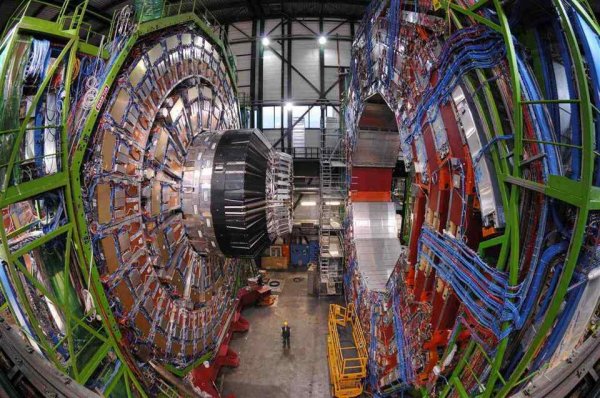
In 2013, physicists at CERN announced that a particle discovered in collisions at the Large Hadron Collider near Geneva was the long-sought Higgs boson. That confirmation capped a half-century of theoretical and experimental work, but the story of the Higgs field and its associated particle began much earlier—and involved more than one scientist.
The puzzle that motivated the work was fundamental: why do some particles have mass while others do not? In the 1960s, the prevailing theory suggested that force-carrying particles should be massless, yet experiments showed that the particles responsible for the weak nuclear force—the W and Z bosons—clearly had mass. That contradiction needed an explanation.
In August 1964, physicists Robert Brout and François Englert published a paper describing a mechanism that could generate mass. A few months later, in October 1964, Peter Higgs at the University of Edinburgh went further, explicitly predicting a new particle—what we now call the Higgs boson. Independently, Dick Hagen, Gerald Guralnik, and Tom Kibble produced similar ideas, publishing their work in November of that same year.
The independent and nearly simultaneous work created a problem for the Nobel committee, which limits the prize to a maximum of three recipients. Ultimately, the 2013 Nobel Prize in Physics was awarded to François Englert and Peter W. Higgs, recognizing their pivotal roles in the theory.
What the Higgs Field Does
Higgs proposed that an invisible energy field permeates all of space. Every particle interacts with this field to some degree, and the strength of that interaction determines the particle's mass. Particles that interact strongly, like the top quark, are heavy; those that interact weakly, like the electron, are light. Without this field, particles would have no mass and would zip through the universe at speeds approaching that of light, making it impossible for atoms—and matter—to form.
A common analogy compares the field to an ocean and particles to fish. A herring, which moves easily through water, represents a light particle like the electron. A sunfish, which struggles more, represents a heavy particle like the top quark. The analogy is imperfect—particles are point-like and have no physical size—but it helps illustrate the concept of varying interaction strength.
Why the Boson Was Hard to Find
The Higgs boson itself is the quantum carrier of the Higgs field, similar to how the photon carries the electromagnetic force and gluons carry the strong force. But unlike those particles, the Higgs boson is extremely short-lived, decaying almost instantly into other, more stable particles. It is believed to exist for only a septillionth of a second, which makes it extraordinarily difficult to observe.
To find it, scientists at the Large Hadron Collider recreated conditions similar to those just after the Big Bang, smashing particles together billions of times. By sifting through data from trillions of collisions, researchers were able to identify the telltale signatures of the Higgs boson. In mid-2013, CERN officially confirmed that the particle they had found was indeed the Higgs boson.
Why It Matters
The Higgs boson is not just an abstract curiosity. It is central to our understanding of the universe. Because it gives particles mass, it allows atoms to form, and atoms are the building blocks of all matter—including us. In that sense, the Higgs field is part of the reason we exist at all.
The confirmation of the Higgs boson was a landmark achievement in physics, validating a theory that had stood for nearly 50 years. It also opened new questions about the nature of mass, the early universe, and the fundamental forces that shape reality. For now, the Higgs field remains a cornerstone of the Standard Model, the framework that describes the known particles and forces.