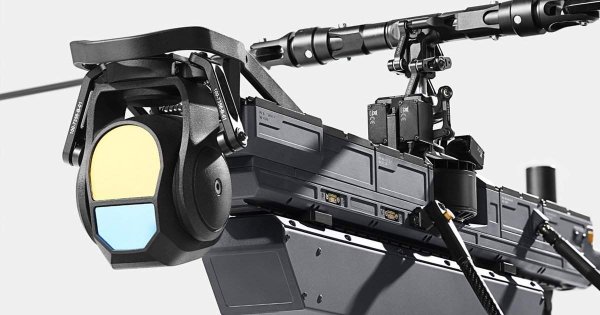
Anduril, the defense technology company co-founded by Oculus Rift creator Palmer Luckey, has introduced a new unmanned aircraft designed to fit inside a standard backpack while carrying a range of mission equipment. The Ghost 4, as the system is called, is positioned as a versatile tool for reconnaissance and electronic warfare, with the company touting its ability to operate in harsh environments including sandy and saltwater conditions.
The drone's two-meter airframe folds down for transport, and its flight endurance is rated at 100 minutes per mission. It can be flown autonomously or under remote pilot control, according to Anduril. The company describes the aircraft as a multi-role platform capable of carrying cameras for surveillance, lasers for target marking, or a radio jammer to disrupt enemy communications. Luckey has referred to the design as a "Swiss army knife" for military operations, though he acknowledged to Wired that weaponizing the drone is a possibility that has not yet been realized.
"It would be possible," Luckey told Wired, "But nobody's done it yet."
AI in the Crosshairs
The Ghost 4's most contentious feature is its integration of artificial intelligence for target identification. Anduril says the system can process and identify targets faster and more efficiently than human operators alone. However, the use of AI in military targeting remains a flashpoint, as evidenced by the cancellation of Google's Project Maven—a Pentagon initiative that applied machine learning to drone imagery—after internal employee protests and public backlash.
Luckey, who left Facebook amid controversy in 2017, argues that the United States cannot afford to avoid AI development in defense. "I don't think we can win an AI arms race by thinking it's not going to happen," he said in a statement, pointing to potential adversaries such as Russia and China.
The introduction of the Ghost 4 comes amid a broader push by the Pentagon to accelerate adoption of autonomous systems. While the drone's immediate role is likely to be intelligence, surveillance, and reconnaissance, its modular design suggests future adaptations could include offensive capabilities.
Critics, however, caution that delegating target selection to algorithms raises ethical and legal questions about accountability in combat. The Ghost 4, for now, remains a platform for observation and electronic attack, but its development signals a growing trend toward AI-assisted warfare.