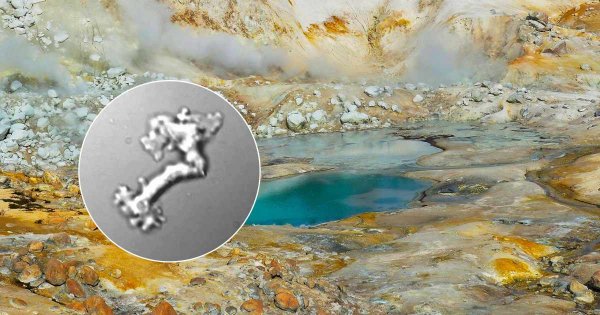
A microscopic organism collected from a hot spring in California's Lassen Volcanic National Park has been shown to divide and move at temperatures up to 145.4 degrees Fahrenheit, setting a new upper limit for complex life forms. The discovery, reported in a preprint study published last week, was made by a team of researchers from American and European institutions.
The organism, a single-celled amoeba now named Incendiamoeba cascadensis — Latin for “fire amoeba from the cascades” — was found in a pH-neutral stream within the park, which is known for its boiling pools and acidic mud pots. According to the study, the amoeba remained active even at 146.3 degrees, but entered a dormant, cyst-like state when temperatures reached 158 degrees.
The finding is significant because it challenges the long-held view that only prokaryotes — organisms without a distinct nucleus, such as bacteria and archaea — can survive extreme heat. Prokaryotes have been documented to endure temperatures between 149 and 221 degrees, with one archaean, Methanopyrus kandleri, holding the all-time record at 251.6 degrees. In contrast, the previous upper limit for eukaryotes — organisms with membrane-bound nuclei, including animals, plants, and fungi — was thought to be between 131 and 140 degrees.
“We need to rethink what’s possible for a eukaryotic cell in a significant way,” said Angela Oliverio, a microbiologist at Syracuse University and co-author of the study, in comments to Nature.
Unexpected Discovery in a Quiet Stream
The team initially saw no signs of life in water samples taken from the stream, which is described by co-author Beryl Rappaport as “the most uninteresting geothermal feature you’ll find in Lassen.” However, after adding nutrients and heating the samples to 134.6 degrees — the stream’s natural temperature — the researchers observed the amoeba moving and reproducing. Further heating to 145.4 degrees did not stop its activity.
The amoeba’s genome was sequenced and analyzed, revealing an enrichment of genes involved in protein regulation, genome stability, and environmental sensing. These mechanisms likely allow the cell to maintain function under heat stress, the scientists wrote.
The discovery opens new avenues for research into heat-loving eukaryotes, which have been largely overlooked in favor of prokaryotic thermophiles. “We looked in one stream,” Oliverio said. “Maybe we got extremely lucky and there’s nothing else out there, but we really don’t think that’s the case.”
Potential Applications and Implications
Beyond expanding the known limits of life on Earth, the fire amoeba’s heat-stable proteins could have practical uses in biotechnology, where thermostable enzymes are valuable for industrial processes. The study also raises speculative questions about the possibility of complex microbial life on other planets, such as Mars, where similar geothermal environments may have existed.
The research has not yet undergone peer review, but it has already captured the attention of biologists who study extremophiles. The team’s findings suggest that eukaryotes may be far more adaptable to high temperatures than previously assumed, prompting a broader search for similar organisms in other hot springs around the world.
For now, the fire amoeba stands as a testament to the resilience of life, even in places that seem inhospitable to almost everything else.