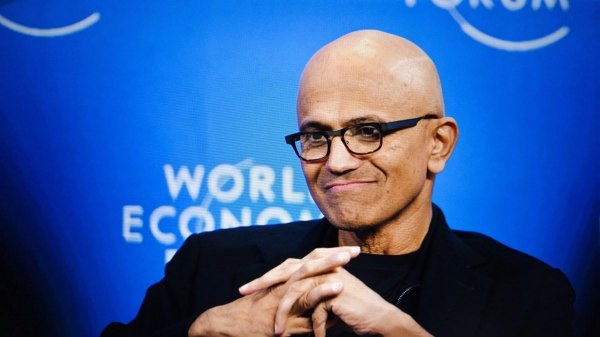
Microsoft chief executive Satya Nadella has issued a stark warning to businesses that lean too heavily on third-party artificial intelligence services: without retaining control over their data and AI processes, they risk losing their competitive edge—and potentially their very existence. In an interview aired Sunday on CNN's Fareed Zakaria GPS, Nadella argued that companies must avoid outsourcing their core thinking to external AI models, a practice he says could prove fatal.
Nadella's remarks come amid growing concerns over the escalating costs of AI adoption, as businesses face hefty token bills from proprietary AI providers. He advised that firms should retain all data generated from employee interactions with AI tools, including prompts and proprietary information, so they can eventually train or fine-tune their own open-weight models. To achieve this, he recommended the use of AI gateways—protective intermediaries that manage data flow between users and AI systems.
“Any firm that doesn’t have this control, I will claim will not remain a firm because you’ve essentially outsourced your thinking,” Nadella said during the interview, as reported by TechCrunch.
The statement is striking, given that Microsoft is a leading vendor of AI software, and outsourcing cognitive tasks is often seen as the primary benefit of such tools. Yet Nadella's advice reflects a broader industry shift toward open-weight models, which are gaining traction as cheaper alternatives to the closed-source systems offered by top AI labs. In AI terminology, “weights” are the numerical parameters that determine how a model processes information; “open-weight” models make these parameters publicly accessible and free to download.
Nadella also cautioned against the use of “harnesses”—the software frameworks that wrap around proprietary models like Anthropic's Claude Code. Instead, he urged companies to build custom AI platforms that can integrate multiple models, including cost-effective open-weight ones. “By keeping the harness separate from the model and the context and memory separate from the model, you absolutely can use multiple models for what they’re great at,” he explained. “At the same time, any one model can go away, and you can still continue to be in control of your own destiny.”
Observers note that Nadella's stance aligns with Microsoft's commercial interests: the company's Azure cloud infrastructure is a popular platform for running open-weight models, and increased adoption of such models could boost its cloud business. However, his advice appears inconsistent when applied to individual consumers. In the same interview, Nadella suggested that regular users should be more willing to exchange personal data for free AI services, drawing a parallel to the advertising-based business model. “To some degree there’s got to be some value exchange in the consumer space where you’re getting something for free, maybe for your data,” he mused.
Why This Matters for Enterprise AI Strategy
Nadella's comments underscore a growing tension in the enterprise AI landscape: while proprietary models offer convenience and power, they also create dependencies that may not align with long-term corporate resilience. For businesses, the decision to adopt open-weight models involves trade-offs between cost, control, and capability. The advice to use AI gateways and maintain data sovereignty is a practical step for firms seeking to mitigate risks associated with third-party AI reliance.
As the AI industry evolves, the debate over open versus closed systems is likely to intensify, with implications for how companies manage their data, their technology stacks, and their strategic autonomy.